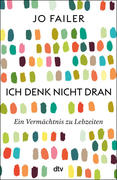
Jo Failer's Ich denk nicht dran: An Unprecedented Insider's View of Dementia
Dementia is a diagnosis that casts a long shadow, often evoking fear, misunderstanding, and a sense of impending loss. Yet, what if we could journey into its earliest stages, guided by someone experiencing it firsthand? Jo Failer's profound book, Ich denk nicht dran (I Don't Think About It), offers precisely this — a rare, authentic, and deeply personal look into the world of early-onset Alzheimer's, challenging preconceived notions and illuminating the enduring capacity for life and joy. This isn't just another book on Alzheimer's; it's an invitation to understand, empathize, and redefine what it means to live with a condition that touches millions.
The title itself, "Ich denk nicht dran," is deceptively simple. It doesn't imply denial, but rather a conscious choice to live in the present, to focus on what remains, and to defy the encroaching shadows with an unwavering spirit. For anyone seeking to understand dementia from an insider's perspective, or for those supporting loved ones through similar journeys, Jo Failer Buch is an indispensable resource.
Unveiling the Human Experience of Early-Onset Alzheimer's
When Jo Failer received the diagnosis of early-onset Alzheimer's at just 51, he was still very much in the prime of life: a professional career, a loving partner, two young children, and a wide circle of friends. This context makes his narrative particularly impactful. Unlike typical medical texts or dispassionate clinical analyses, Ich denk nicht dran plunges readers into the lived reality of a vibrant individual grappling with a life-altering condition. Failer's courage lies in his attempt to "make the disease visible, as long as he still can." This urgency lends a raw authenticity to every page, capturing the nuances of memory, perception, and identity as they begin to shift.
The book tackles the common fears surrounding dementia head-on, not by offering platitudes, but by sharing vulnerabilities and moments of profound insight. It demonstrates that life doesn't simply stop at diagnosis; it transforms. Failer invites us into his thoughts, his daily struggles, and his surprising discoveries, offering a narrative that is both heartbreaking and hopeful. This intimate portrayal helps bridge the gap between those living with dementia and those around them, fostering a deeper understanding that transcends mere sympathy.
For families and caregivers, Failer's perspective is invaluable. It provides a window into the inner world of someone experiencing cognitive changes, helping to decipher behaviors and emotions that might otherwise be misinterpreted. It underscores the importance of communication, patience, and a willingness to adapt, emphasizing that the individual, not just the disease, must remain at the center of care.
Beyond Statistics: A Poetic Glimpse into Dementia
What sets Jo Failer Buch apart is its deliberate departure from the dry, statistical language often associated with medical conditions. As the description notes, it is "no medical treatise, but a poetic, authentic, and entertaining non-fiction book." This poetic sensibility is key to its power. Failer doesn't present a clinical case study; he crafts a narrative rich with metaphor, personal observation, and emotional depth. He humanizes the experience of Alzheimer's by focusing on subjective reality, the fragmented beauty of fading memories, and the persistent spark of personality.
Eckart von Hirschhausen, a renowned German physician and author, eloquently praised the book: "Impressive how Jo Failer emotionally makes us experience the inner view of early dementia. An important book about an illness that concerns us all!" This endorsement highlights the book's unique ability to foster empathy and make the complex internal world of early dementia accessible to a broader audience. By embracing a poetic narrative, Failer encourages readers to look beyond the clinical symptoms and connect with the individual's ongoing journey.
This approach allows readers to grasp the subtle shifts in cognition, the struggle to articulate thoughts, and the moments of clarity and confusion in a way that statistics never could. It's a testament to the power of narrative to illuminate the human condition, even amidst the most challenging circumstances. To delve deeper into how Failer achieves this, consider Jo Failer's Book: Making Early Alzheimer's Visible.
Finding Life and Joy Amidst the Fading Memories
Perhaps the most uplifting aspect of Ich denk nicht dran is its unwavering focus on the possibility of joy and meaning, even after a devastating diagnosis. Failer's story is a powerful counter-narrative to the common perception that life ends with Alzheimer's. Instead, he demonstrates how much joy in life is still possible despite everything, offering a beacon of hope for those navigating similar paths.
This perspective is crucial for both individuals living with dementia and their support networks. It encourages a shift from focusing on what is lost to appreciating what remains. Failer highlights the importance of living in the present, finding solace in familiar routines, engaging in meaningful activities, and cherishing relationships. His book implicitly offers actionable advice: prioritize quality of life, maintain social connections, encourage creative expression, and adapt expectations with compassion and understanding.
For caregivers, this message is particularly resonant. It reminds them that their role extends beyond practical care to nurturing joy, fostering dignity, and celebrating every moment. It's a call to embrace the journey with resilience and love, recognizing that even as memories fade, the capacity for connection and happiness endures. Explore more about this aspect in Finding Joy with Alzheimer's: Jo Failer's Poetic Memoir.
Tips for Cultivating Joy in Early Dementia:
- Focus on the Present: Encourage engagement in activities that bring immediate pleasure and satisfaction, rather than dwelling on past memories that may be challenging to recall.
- Maintain Routines: Familiar daily structures provide comfort, predictability, and a sense of security.
- Engage the Senses: Music, art, nature walks, and aromatic experiences can evoke positive emotions and memories, bypassing cognitive challenges.
- Prioritize Social Connection: Continued interaction with friends and family helps combat isolation and reinforces identity.
- Simplify Choices: Offering fewer options can reduce frustration and promote a sense of autonomy.
- Encourage Creative Expression: Painting, drawing, writing, or playing an instrument can be powerful outlets for emotion and communication.
The Artist Behind the Words: Jo Failer's Broader Creative World
To fully appreciate the depth and unique perspective of Ich denk nicht dran, it's essential to understand Jo Failer's background as a prolific artist and academic. Born in Tapfheim (on the Danube) in 1993, Jo Failer (also known as Johanna Failer in her artistic endeavors) is a highly accomplished visual artist, currently pursuing a doctoral degree at the HFBK Hamburg, researching Catholic motifs in contemporary art. Her extensive studies in Fine Arts at institutions like HFBK Dresden and École Supérieure des Beaux-Arts Bruxelles, coupled with numerous residencies, scholarships, and exhibitions across Europe, testify to a profoundly introspective and creative mind.
Failer's artistic series, such as "22:22," delve into the intricate relationship between humans, objects, and imagination. Inspired by Hannah Arendt's "Vita activa," her work explores how individuals construct their own worlds and find meaning in persistent, tangible things. This artistic lens profoundly shapes her approach to writing about dementia. Her ability to observe, interpret, and construct meaning from subjective experiences, much like an artist crafts a visual world, allows her to articulate the often-ineffable sensations of cognitive change. The book itself can be seen as an extension of her artistic practice – a profound effort to create a tangible representation of an internal, abstract experience.
Her numerous accolades, including awards like the Kunstpreis Sevilla Crea and prominent residencies, underscore her commitment to creative exploration. This rich artistic and academic foundation provides her with a unique vocabulary and framework to articulate an experience that often defies conventional description. It's this fusion of raw personal experience with an artist's keen observational skills and reflective depth that makes Ich denk nicht dran so impactful and unlike any other account of dementia.
Conclusion: A Vital Contribution to Dementia Awareness
Jo Failer's Ich denk nicht dran is far more than a personal memoir; it's a vital contribution to our collective understanding of dementia. By sharing his journey with courage, honesty, and a profound artistic sensibility, Failer not only demystifies early-onset Alzheimer's but also offers a powerful message of hope and resilience. His book challenges us to move beyond fear and stereotypes, encouraging empathy, understanding, and a focus on the enduring human spirit.
For anyone touched by dementia, directly or indirectly, or for those simply seeking a deeper understanding of the human condition, Jo Failer Buch is an essential read. It reminds us that even when thoughts slowly fade, the capacity for life, joy, and meaningful connection can persist. It is a powerful testament to the individual's journey and an urgent call for greater awareness and compassion.